
Yeast and pitching
Yeast decides where the beer finishes, and pitching enough of it decides how cleanly it gets there. The Yeast panel holds the cultures; the Starter dialog and the Checks card answer whether the pitch is enough.


The panel
Section titled “The panel”Add a strain with Add yeast or press A anywhere in the editor and search. Each row shows the strain, its Form (dry or liquid), its attenuation, its temperature range and the number of Packs.
Atten. % is the figure the final-gravity prediction uses. Left alone, it shows the mid-point of the lab’s published band, and a line under the table says so in words: “US-05 attenuates 78–82 %; predicted FG uses 80 %.” Type a number to override it. You know your fermenter and your wort better than a published band does, and the override is the place to say so.
With no yeast in the recipe, the prediction falls back to a default attenuation, and the panel tells you that too.
Enough yeast?
Section titled “Enough yeast?”The Checks card in the vitals rail watches the pitch. It says nothing while the pitch is at ninety percent or more of the target. Below that it adds a note, and below three quarters the note becomes a warning. The sentence says what the pitch comes to, what the target is, and which of two things would close the gap: a starter, or a number of packs.
Dry yeast is judged differently, and on purpose. A dry pitch is compared against the maker’s own dose in grams per hectoliter, not against a cell count. Fermentis print 50 to 80 for their ales and 80 to 120 for their lagers, and Lallemand sit in the same country. Dry yeast ships with the glycogen and sterol reserves a liquid pitch has to build in the wort, so a by-the-book lager sachet reads as a heavy under-pitch on the cell-count scale. Judged that way you would want five sachets where the maker asks for under two, which is a wrong answer delivered confidently. So the check says “the pitch comes to 11.5 g, under the 80–120 g/hL its maker recommends” and leaves cells out of it.
The same check says when a dry pitch is heavy, but only when dropping a whole sachet would still clear the floor. Some batch sizes have no whole number of sachets inside the maker’s band, and a warning you cannot act on is noise.
The starter dialog
Section titled “The starter dialog”Press Starter in the panel header. It is a calculator you stand in front of with a flask: the rate, the volume and the agitation are yours to try, and none of them is saved until you save a starter. The pack’s date is the exception. It is a fact about the pack rather than a what-if, so it is kept on the yeast as soon as you type it, made-on or best-by, and a batch brewed from the recipe starts from it.
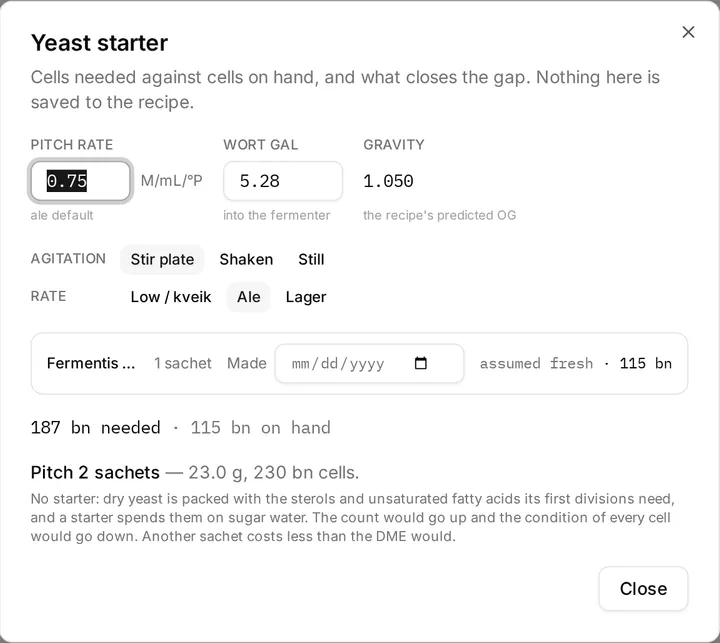
The top shows the pitch rate, in million cells per milliliter per degree Plato, with the default for the first strain’s type: 0.75 for ales, 1.5 for lagers. Those are the long-standing figures from White and Zainasheff’s Yeast, and lagers get double because they ferment cold and slowly. Switch Rate to Low / kveik for 0.35 when under-pitching is the technique rather than the mistake, or type your own. Wort starts at the volume going into the fermenter and Gravity is the recipe’s predicted OG.
Each culture gets a row with its packs and a Made date. Leave the date empty and the pack is assumed fresh. Fill it in and the row shows the viability and the cells it implies. Liquid yeast loses about a fifth of its viability a month in the fridge; dry yeast loses about a fifth a year. The curve is exponential rather than the straight line most calculators use, so it never hits an arbitrary floor, and the same curve is used here and in the Checks card, so you cannot read two different figures for one pack.
The date is not written back to the recipe. A calculator quietly changing an ingredient row is a worse surprise than a date that has to be retyped.
What it answers
Section titled “What it answers”No starter needed. The viable cells clear the target, so pitch it as it is.
Pitch two sachets. An all-dry pitch never gets a starter, and the dialog says why: dry yeast is packed with the sterols and fatty acids its first divisions need, and a starter spends them on sugar water. The count would go up and the condition of every cell would go down. Another sachet costs less than the DME would. Fermentis, Lallemand and White and Zainasheff all say the same.
A plan. Otherwise we size a starter for you: one step or two, never three, on a quarter-liter grid up to four liters a step. Pick the Agitation you have, in the order they cost money: a stir plate, a shaken flask, or a still one. The plan lists each step’s volume, its DME and what it yields. Starter volumes are always in liters whatever your unit preference, because a starter is built in a flask and flasks are liter-denominated everywhere.
The wort is ten parts water to one of DME by weight, which lands at 1.037. That is not a variable, because Kai Troester’s measurements found five, seven and ten degrees Plato grow the same yeast while twenty grows visibly less. His growth model is what sizes the plan, and he puts it at plus or minus fifteen percent or worse. Treat a plan that only just clears the target as not clearing it.
Not reachable in two steps. Start from more yeast, and the dialog says how much: a number of packs, or one fresh one, rather than a third step. Three steps is a laboratory propagation schedule, not a homebrew Saturday.
Saving it. The plan always answers the numbers on screen, so change the date, the rate or the agitation and it moves. Save this starter keeps it. Once one is saved it sits in a line under the plan with what it grows at these numbers and whether that still clears the target. If the plan now differs, Replace the saved starter swaps it; if they agree there is nothing to press; and if no starter is needed any more, Remove the saved starter is the button that leads.
On the calendar
Section titled “On the calendar”A saved starter puts Starter on the calendar ahead of the batch’s brew day, with the culture and the step volumes on it, and it rides the subscribed feed like every other date. Two days ahead is the default, because a stirred starter is at high krausen inside a day and has flocculated by the second, which is what you want on brew morning: the yeast dropped, the spent wort ready to decant. If you build yours the night before, or earlier, set the lead under Settings → Calendar and every planned starter moves. Move the brew day and the starter moves with it. A batch whose recipe never saved a starter can still have one put on a day by hand, from the calendar’s Schedule button.
Once you tell a batch which jar you are using, the batch starts from the recipe’s starter and keeps its own from then on, on the batch page’s Yeast panel. A recipe plans for a pack of the right strain; the jar in your fridge has a generation and an age of its own, and those come to different numbers, so the panel says when the planned starter no longer covers the jar and you can resize it there. From the moment a jar is chosen, the starter on the calendar is the batch’s, and there is no starter date at all if you cleared it because the jar was fresh enough to pitch neat. The recipe’s own starter stays exactly where it is, ready for the next brew.
Related
Section titled “Related”- The calendar, where a saved starter gets its date.
- The recipe editor, for the panel in context.
- The brew sheet, which prints the pitch line only when there is a starter to make.
- Mash and fermentation, for what the yeast wants once it is in.
Something wrong on this page? Tell us.