
Decoctions
A decoction is part of the mash pulled into a pot, boiled, and stirred back in. The heat it brings back carries the rest of the mash up to the next rest.
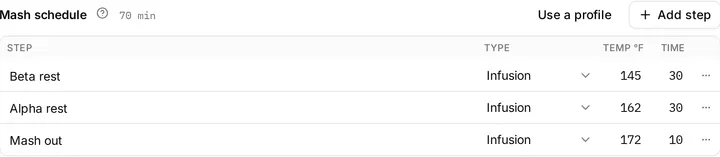
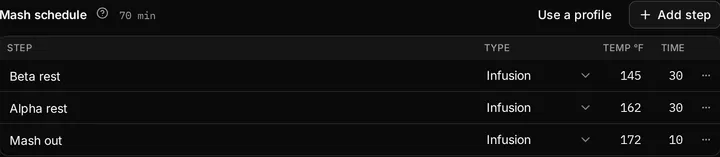
Set a mash step’s type to Decoction and the row underneath tells you what to lift out. Click it to open the planner.
What the planner tells you
Section titled “What the planner tells you”For each pull:
- How much to pull, as a pot reading and as grain and liquid separately — because you scoop grain with a spoon and read liquid off the side.
- How long it is out, counting the conversion rest, the ramp to boil, the boil and the return. Usually longer than people expect.
- How far the tun drifts while the pot is off it.
- How much the boil takes in water.
And across the whole schedule: what it adds to your brew day, how much water the pots boil away, and how thick the mash finishes.
Thick, medium or thin
Section titled “Thick, medium or thin”Thick is grain scooped from the bottom and drained on the spoon. It carries the most malt character and the most scorch risk, and it is the traditional pull.
Medium is the usual compromise, about 1.5 liters of liquid per kilogram of grain.
Thin is liquid only. It is a temperature tool rather than a flavor one: there is no grain in it, so no starch to gelatinise and little of the Maillard character a decoction is usually done for. It is the right answer for a mash-out, where there is nothing left to gain from boiling more grain.
A thick pull is the bigger bucket, which surprises people. Grain solids are dense but carry only about 0.4 of water’s specific heat per kilogram, so a liter of them holds roughly 0.6 of the heat a liter of water does. To move the same temperature you need about 19 % more pot.
It also means what usually runs out is grain, not water. A thick pull from a thin mash is grain-rich relative to the tun, so on a big step you run out of grain long before you run out of liquid. If the planner refuses, a thinner pull is usually the fix rather than a smaller one.
The conversion rest
Section titled “The conversion rest”A pull taken from a protein rest is full of unconverted starch, and boiling unconverted starch sets it and loses the extract. Traditional practice holds the pull near 70 °C until it converts, then boils it. Add a conversion rest does that; the shipped thick-pull schedules all have one.
Why the numbers are bigger than the textbook’s
Section titled “Why the numbers are bigger than the textbook’s”The formula in most calculators assumes the tun does not cool while the pull is out, that the pull comes back at a full 100 °C, and that the boil costs no water. All three are wrong, and all three wrong in the same direction, so the textbook pull is too small and the mash lands short.
Beerwright sizes the pull against the mash as it will be when the pull comes back: after the tun has drifted, at the temperature the pot actually returns at, allowing for the water it boiled away. Set your equipment profile’s standing loss to 0 if your rig holds mash temperature for you, and you will get the textbook answer, because that is the case the textbook describes.
Your rig
Section titled “Your rig”Three fields on the equipment profile, and they do nothing until a schedule has a decoction in it:
- Mash standing loss — how fast your mash cools with the lid on. Set it to 0 if your rig holds temperature for you. This is the biggest single correction the technique needs.
- Decoction pot boil-off — evaporation from the pot, not the kettle. It never reaches the boil, so it is added to the water you need.
- Decoction pot — only used to warn you when a pull would not fit.
What we will not tell you
Section titled “What we will not tell you”Three things, and the omissions are deliberate.
Color. Decoction darkens wort. How much is process-specific and the published figures disagree, so we do not model it. A confident number would be worse than none.
Efficiency. With modern well-modified malt the gain is small and with undermodified malt it is larger and unquantified.
Mash pH. Boiling a pull precipitates calcium phosphate and drives off CO₂. The effect on the finished mash is small and disputed in direction. The water panel’s prediction is an infusion-mash prediction; a decoction mash typically measures within about 0.05 pH of it.
Fermentability treats a decoction rest exactly like any other rest, because the rest temperature is what the enzymes see and how the tun got there is a process detail.
Related
Section titled “Related”- Mash and fermentation, for the schedule a decoction step sits in.
- How decoctions are worked out, for the arithmetic.
- Water chemistry, for what boiling a mash does to pH.
Something wrong on this page? Tell us.