
Flavor
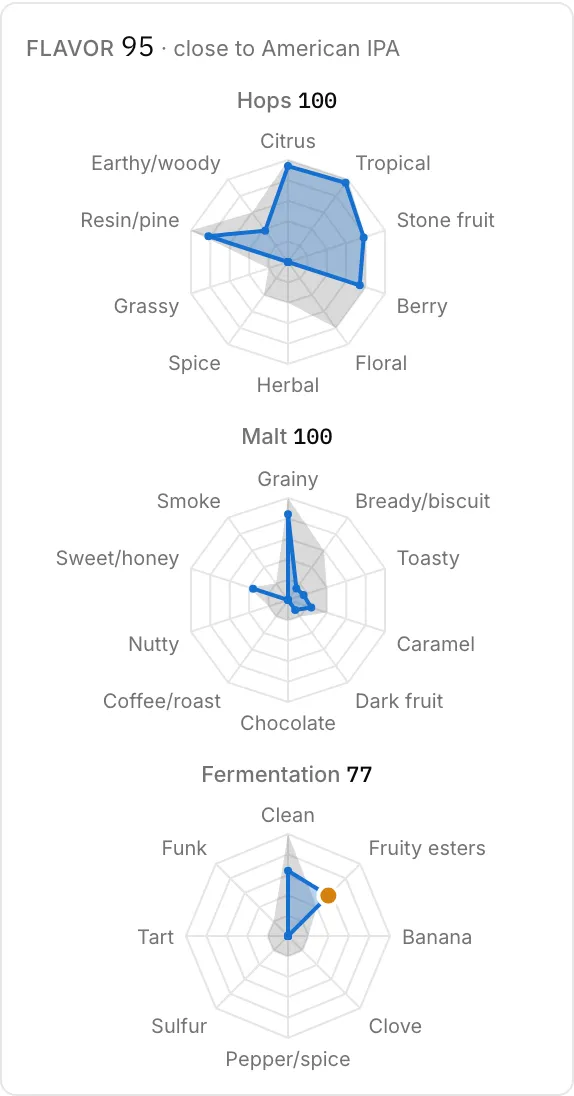
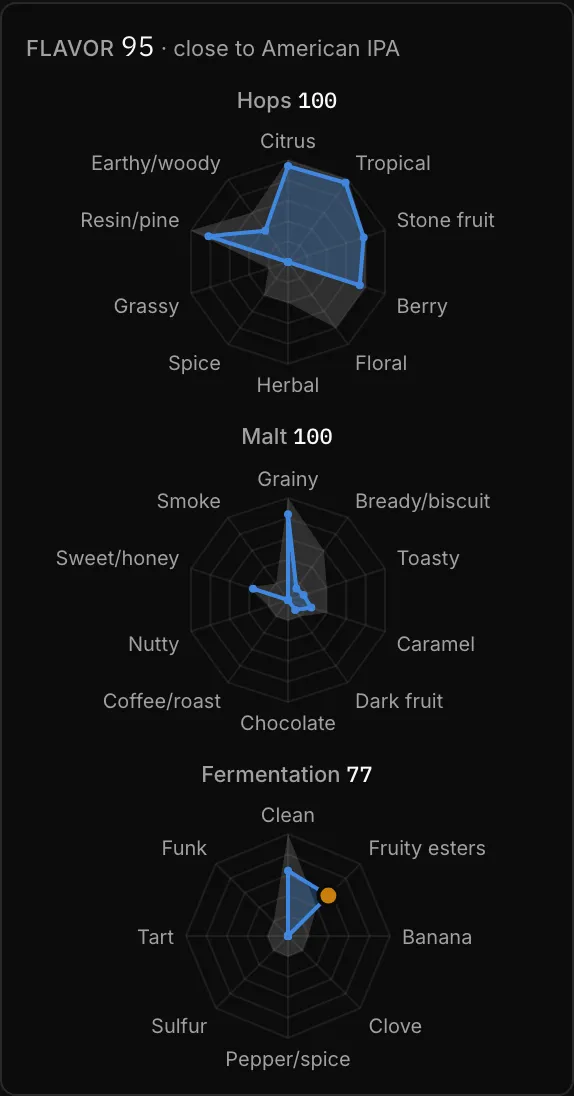
The style bars tell you whether your numbers are in range. The Flavor card under them asks the next question: does the recipe carry the flavors the style is known for? It draws what we expect your beer to taste like as three wheels, shades in what a typical beer in the style tastes like, and gives you one number for how close the two are.
The three wheels
Section titled “The three wheels”Each wheel has its own set of axes, and each axis runs from 0 at the center to 5 at the rim.
- Hops: Citrus, Tropical, Stone fruit, Berry, Floral, Herbal, Spice, Grassy, Resin/pine and Earthy/woody.
- Malt: Grainy, Bready/biscuit, Toasty, Caramel, Dark fruit, Chocolate, Coffee/roast, Nutty, Sweet/honey and Smoke.
- Fermentation: Clean, Fruity esters, Banana, Clove, Pepper/spice, Sulfur, Tart and Funk.
The wheels measure how much of each character the recipe delivers, not just which characters it has. An over-hopped Helles reads as too big on the hop wheel rather than as the right shape, and that is the point of drawing it this way.
How the recipe fills them
Section titled “How the recipe fills them”Every ingredient in the catalog carries a typical character, and we add up what you put in.
Hops count by weight per liter of fermenter volume, so the same 50 g means more in a 10 liter batch than in a 40 liter one. When a hop goes in matters as much as how much of it you use, because the aroma is carried by oils that heat drives off:
- A dry hop or a keg hop counts in full.
- A whirlpool addition counts less the hotter the stand. A stand at 70 °C or below counts in full, and one near boiling keeps less than half. If you leave the stand temperature blank, we assume 80 °C, as the IBU does.
- A boil addition fades with time. A flameout charge keeps most of its character, ten minutes keeps less than half, and a 60-minute bittering addition adds almost nothing.
- A first wort hop adds almost nothing.
Adding more of a hop keeps pushing its axes outward, but the wheel fills up toward 5 and levels off there, the way a beer can only taste so much of grapefruit.
Malt counts by its share of the grist, not its weight, so a recipe scaled up or down draws the same wheel. Darker and more characterful malts push harder than base malt: a few percent of roasted barley moves Coffee/roast further than the same share of Pilsner malt moves Grainy.
Fermentation comes from the yeast. When the recipe has a primary fermentation step, we read its temperature against the strain’s own range. Toward the warm end the wheel reads more estery, with more fruit, banana, clove and pepper; toward the cool end it reads cleaner. With no primary step we read the strain as if fermented in the middle of its range. If the recipe uses two yeasts, each axis takes the stronger of the two rather than their sum, because two clean strains together do not make a beer twice as clean.
The shaded band
Section titled “The shaded band”The shaded ring on each wheel is what a typical beer in the style tastes like, as we read the BJCP 2021 guidelines. Each style names the handful of axes that define it and a range for each. An axis the style doesn’t name is “not characteristic”, which still allows a trace of it, so a German Pils is allowed a whisper of citrus but not a mouthful.
Where your recipe sits outside the band, that point on the wheel turns amber, the same way a style bar does. On a desktop, hover a point to read its value. On a phone or tablet, where there is nothing to hover, each wheel lists its worst misses underneath it instead, up to three, in the same words as the popover below.
You can see a style’s bands on their own, before you have a recipe, in the style’s detail on the ingredients page, under “What it tastes like”.
The number
Section titled “The number”The number at the top of the card runs from 0 to 100, always whole. Each wheel has its own score, shown above it, and the headline is those three weighted by how much each wheel defines the style. A Weissbier leans on fermentation and an IPA leans on hops, so a miss on the wheel the style cares about most costs the most. Even so, one wheel far out of its bands holds the headline down, so a light lager dry-hopped like an IPA can’t score as close. Beside the number the card says whether you are close to the style, some way from it, or far from it.
An axis inside its band costs nothing. Outside, it costs more the further out it sits, and the score falls away smoothly rather than hitting zero.
Press the number and a popover lists the biggest misses, largest first, each with the ingredient mostly behind it: “Resin/pine 3, style wants 0 to 1: mostly Chinook in the dry hop.” That is the part to act on. When the yeast ran outside its published range, the line blames the temperature rather than the strain: “Fermentis SafLager W-34/70 fermented at 68 °F, above its 48 to 59 °F range.”
What the number is not
Section titled “What the number is not”This is an estimate from each ingredient’s typical character and how much of it goes in. It can’t taste your beer. It knows nothing of your water, your hop’s crop year, how your fermentation actually went or how long the beer sat before you drank it. Treat it as a second opinion on the recipe, and trust your own glass over it.
When there is no number
Section titled “When there is no number”The card draws your recipe’s wheels whatever the style, and only scores it when there is something to score against.
- No style picked. The card asks you to pick one.
- A style we haven’t profiled yet. We are writing profiles a style at a time, so the set is growing. Until your style has one, the card says so and draws the wheels without a number.
- A style with no fixed profile. Some styles, like fruit and spice beers, will have no fixed profile, because they depend on what you put in them. For those the card will say there is nothing to score against.
Custom ingredients
Section titled “Custom ingredients”A custom malt still scores, from its class and its color, the same way a catalog malt with no special handling does. A custom hop has nothing for us to read, so it adds nothing to the hop wheel. A custom yeast is read from its type, ale, lager, wheat and so on, and only one set to Other adds nothing. Whatever we can’t read is listed under the wheels as having no flavor data, so you know the wheels are missing it.
Elsewhere
Section titled “Elsewhere”The same card, read-only, appears on a shared recipe. The assistant reads the same numbers, so you can ask it which ingredient is pulling your beer off style, and its answer will come from these wheels rather than from tasting notes it made up.
Related
Section titled “Related”- Styles, for the style bars and the rest of the style.
- Hops, for uses, times and the whirlpool temperatures.
- The recipe editor, for the vitals rail in full.
Something wrong on this page? Tell us.