
Styles
A style is a target to aim at, and in Beerwright it is a quiet one. Pick a style and the editor draws its ranges under your numbers so you can see where you stand. It does not stop you brewing outside them, because a hoppier ordinary bitter than the guideline allows is not a mistake. It is a recipe.
The catalog
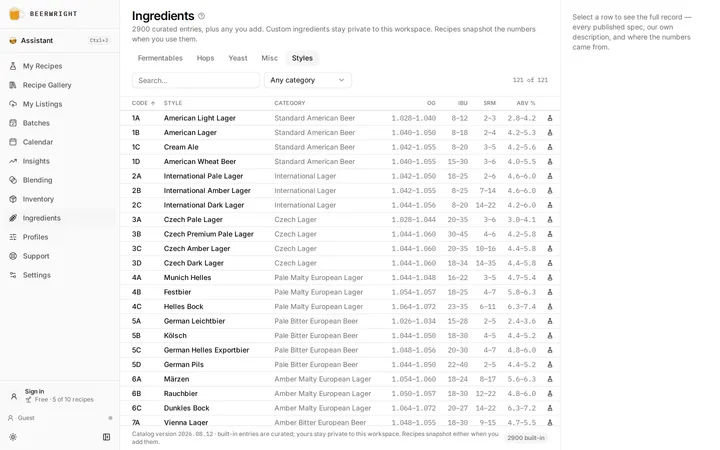
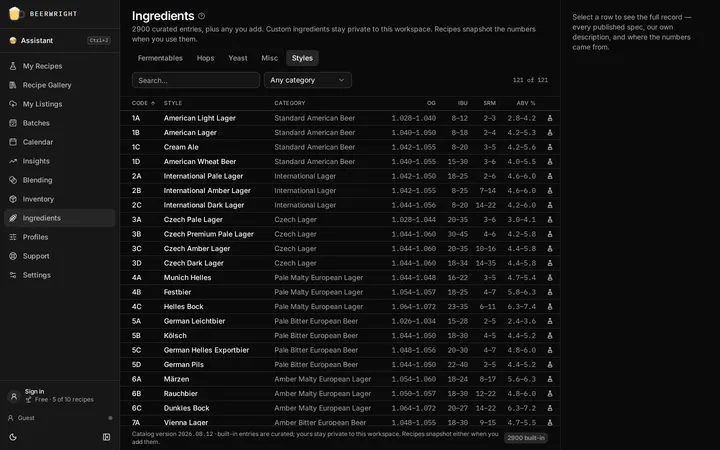
Section titled “The catalog”We carry the full 2021 BJCP beer set: 116 styles across the 34 numbered categories, plus the five provisional styles the BJCP has published since. Each style carries its code, its category, and the published ranges for original gravity, final gravity, bitterness, color and alcohol.
The description and the commercial examples are our own words. We do not reproduce the guidelines’ text, and a style’s entry here is a summary you can act on rather than a copy of the book.
Eighteen styles publish no ranges at all. They are the specialty categories from 28 upward, where the style is “a base style plus something” and the numbers belong to the base. The editor draws no band for those and says so.
Provisional styles
Section titled “Provisional styles”The BJCP adds styles between editions and numbers them X1, X2 and so on, outside the numbered categories. We keep them, and we keep them apart: they sort after category 34, they have no sub-style letter, and the record says they are provisional. A provisional style may be folded into a category or dropped when the next edition lands, so a brewer entering one should know its definition is not settled. The five we carry today are Dorada Pampeana, IPA Argenta, Italian Grape Ale, Catharina Sour and New Zealand Pilsner.
Picking a style
Section titled “Picking a style”In the recipe header, press Style and type. The search reads the name, the category name and the code, so “ipa”, “21” and “saison” all work. Each result shows its ranges on one line, or says “no published vitals” where there are none. Clear style takes the style off again.
You can also start from the style. On the ingredients page the Styles tab lists every style with its ranges, sortable and filtered by category, and Start a recipe on any row makes a new recipe with that style already set.
The style bars
Section titled “The style bars”The vitals rail down the right of the editor draws five bars: OG, FG, IBU, color in SRM or EBC depending on your unit preference, and ABV. Each bar shows the style’s range as a band and your recipe’s value as a mark. Inside the band the mark is calm. Outside it, the mark turns amber and gains an arrow, and hovering it says which way you are out.
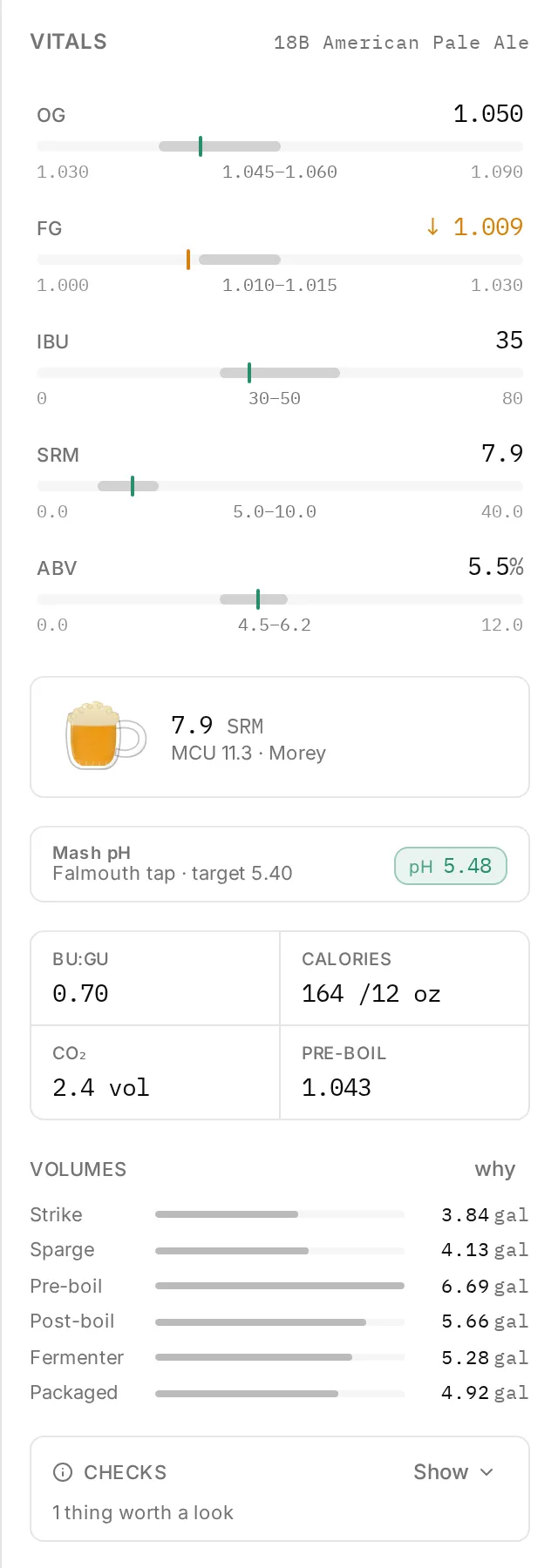
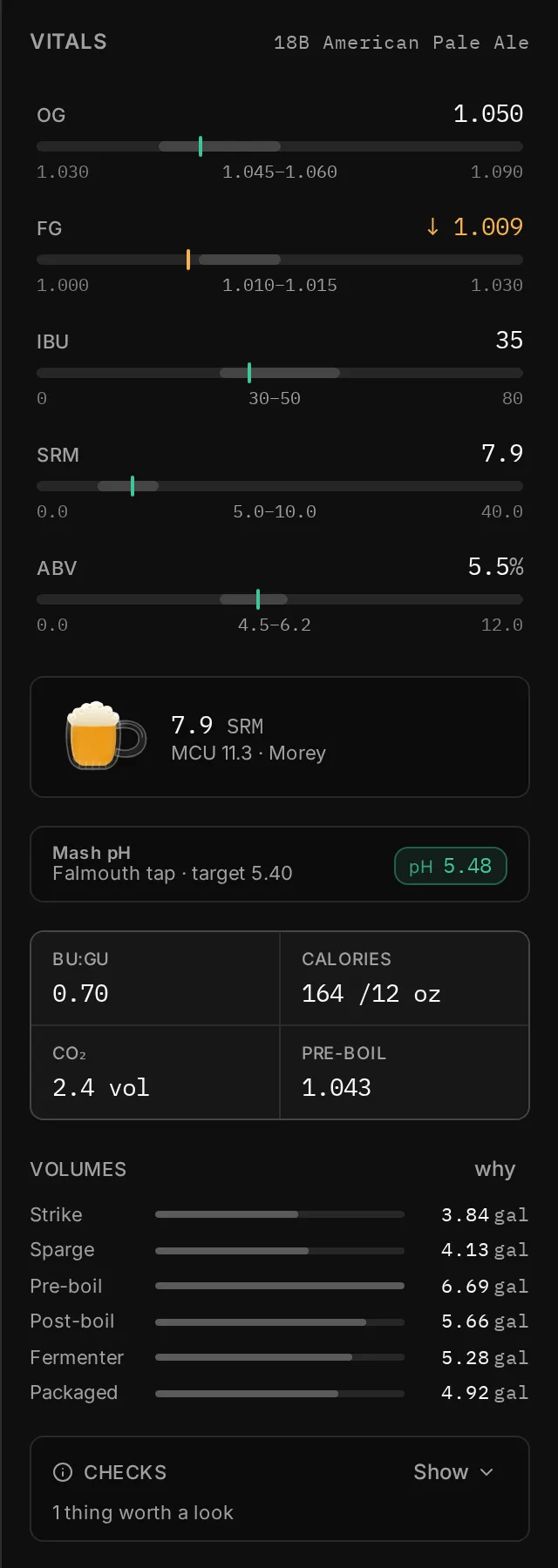
The axis under each bar runs wider than the style, from the lightest beer to the strongest, so the band has room to sit in context. With no style selected the bars still draw your numbers, on a default axis, and each says “no style range” instead of a band.
On a phone the rail becomes a strip docked to the bottom. The bars are there with no axis numbers, and if no style is set the strip says so once above them rather than under every bar.
Every number on the rail opens its explanation when you press it. If a bar is telling you something surprising, that popover shows how the number was worked out.
What the checks say
Section titled “What the checks say”The Checks card at the foot of the vitals rail reads the same ranges. When your OG, FG, IBU or color lands outside the style’s band it adds a note in the form “IBU is above the style’s 30–45.” These are notes rather than warnings, on purpose. The card’s summary line counts them as “things worth a look”.
ABV is not checked separately, because it follows from OG and FG and a third note about the same thing would be noise. With no style selected there are no band notes at all.
The bar color and the check share one definition of “inside the band”, so a value sitting exactly on the top of the range reads the same way in both places.
What styles are not
Section titled “What styles are not”There are no custom styles. The ranges come from the guideline, and a range you wrote yourself would be a target you set for yourself, which the notes field already holds. If you compete under a different guideline or a house style that we should carry, the feature-request board is the place to say so.
Related
Section titled “Related”- The recipe editor, for the vitals rail in full.
- Ingredients, for the Styles tab.
- FAQ, for how the numbers behind the bars are calculated.
Something wrong on this page? Tell us.