
Profiles
Profiles in the sidebar holds the four things you set up once and reuse: your kit, your water, and the two schedules you brew to, one tab each.
The one thing worth knowing first
Section titled “The one thing worth knowing first”The four tabs look alike and they do not behave alike.
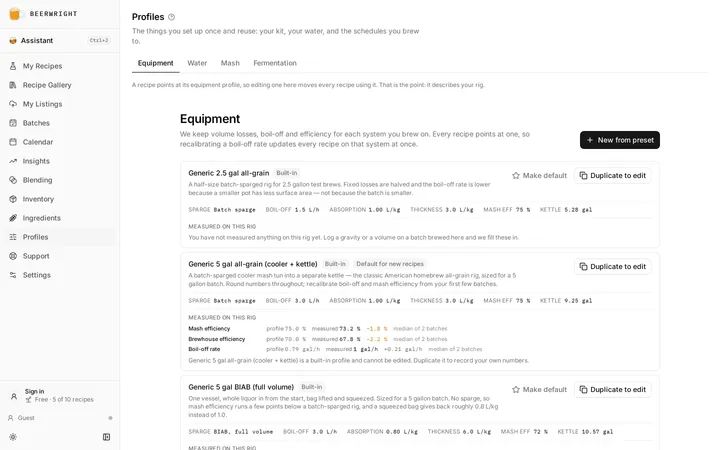
Equipment binds by reference. A recipe stores which profile it uses and reads it fresh every time it calculates. Change your boil-off rate and every recipe on that profile recalculates. That is what you want: it describes a rig that really did change.
Water, mash and fermentation copy. Applying one puts the values into the recipe and the link ends there. Edit “Full body” next month and the beer you designed last week is untouched — including one already in the fermenter, whose brew sheet would otherwise stop matching the beer.
Every tab says which it is, at the top. If you only remember one thing: editing equipment reaches backwards, editing the other three does not.
Equipment
Section titled “Equipment”Your brewhouse: efficiencies, boil-off, the volumes you lose at each step, and the sparge style. There are three built-in profiles and a browser of more than seventy real systems — Grainfather, Anvil Foundry, Brewer’s Edge, BrewZilla, Spike, Clawhammer, Ss Brewtech, Brew Hardware, Blichmann, Brewtools, Speidel, Bräu Supply, MoreBeer, Ruby Street, a generic cooler and a generic BIAB kettle.
Pick the one closest to yours, then Duplicate it and correct the numbers as you measure them. The waterfall chart beside the fields redraws as you type, so you can see what a change does before you brew on it.
The number most worth measuring yourself is boil-off. It moves everything downstream of it and it varies more between two kettles than any published figure suggests.
Some kit has a job of its own that no recipe knows about. A steam condenser’s condensate bucket needs swapping every half hour through the boil, for example. Add it under Brew-day reminders on the profile, with how many minutes apart it comes, and we’ll put it on brew day among the boil additions, on the same clock. A reminder you add today shows up from your next new batch, because a batch keeps the equipment it was started with.
This tab holds your source analyses, plus a set of built-in city profiles. It is where a water report lives once you have one; the recipe’s own water panel is where you treat it.
See Water chemistry for what to do with them.
This tab holds the schedules you mash to. Two kinds ship, and they answer different questions.
Body: which beer
Section titled “Body: which beer”Light body, Medium body and Full body are single infusions at 148, 152 and 156 °F. They are not three temperatures somebody liked — 152 °F is the temperature our attenuation model is built around, and the other two sit an equal distance either side of it. Pick one and the predicted final gravity moves in the direction the name promises.
The tab tells you by how much: “Resting at 148 °F, so we predict about 2.7 points more apparent attenuation than a mash in the middle of the range.”
Cooler favours beta-amylase, which makes maltose, so the beer finishes drier and thinner with a little more alcohol. Warmer favours alpha-amylase and the dextrins it leaves, so the beer is sweeter and fuller with a little less.
Technique: which morning
Section titled “Technique: which morning”Single infusion is one rest and a mash-out, which is what most ale recipes call for and what well-modified malt needs.
Hochkurz step mash steps through a maltose rest at 63 °C to a saccharification rest at 72 °C. It is the modern German lager schedule.
Two hefeweizens, which differ on purpose. Both open with a ferulic acid rest at 44 °C: the enzyme that frees ferulic acid works around there and dies well before saccharification, and the yeast turns that ferulic acid into the clove phenol. Traditional then steps through the Hochkurz rests and finishes dry. Ester-forward skips the maltose rest and sits at 156 °F instead — with less maltose in the wort, glucose makes up a larger share of the sugars, which favours the banana at the cost of a fuller finish.
Two lambic mashes. Turbid mash is the traditional schedule seen from the tun: an acid rest, stepped infusions, a warm rest and a hot mash-out, written for a grist that is a third raw wheat. The starchy pulls you draw off after the 58 and 65 °C rests are yours to hold near 88 °C and return — we chart the rests the enzymes see, and the description on the profile walks the pulls. Mock turbid is the one-vessel shortcut American coolship brewers run: fifteen minutes at 74 °C, hot enough that conversion loses the race, so the starch a Brett beer wants survives without the second kettle.
Three decoctions — single, double and the Bohemian triple. See Decoctions.
Saving your own
Section titled “Saving your own”Build a mash on a recipe, then Use a profile → Save this mash as a profile. It appears under “Yours” in the same menu on every other recipe.
You cannot edit ours. Apply one, change it on the recipe, and save that as your own — the tab says so when you select a built-in.
Fermentation
Section titled “Fermentation”Fermentation is the same idea. Eleven schedules ship, and each one is there for a mistake it prevents rather than for a beer it belongs to.
Clean ale is two weeks at one temperature, which is what most ale yeast wants. Clean ale, cold crashed spends the last two of those days cold, so the yeast and haze drop and the beer arrives at packaging holding a little more CO₂.
English ale, cool drop finishes a week warm and then sits a cool fortnight, because English yeasts flocculate hard and drop bright if you let them.
Hazy IPA free-rise holds three days at 18 °C and then lets the beer climb to 21. Belgian free-rise does the same in two days and climbs to 25: holding a Belgian cool the whole way is the classic mistake, since the spice and stone fruit are made by the rise. Saison, hot finish starts at 24 °C and finishes at 29, which is what gets a saison through the last few gravity points instead of stalling there.
Hefeweizen stays cool and is left alone, and Kveik is pitched hot and is often done in four days.
Lager with a diacetyl rest is the reason this library exists. Cold primary, a warm rest so the yeast clears the butterscotch it made, then weeks of cold conditioning is three decisions you would otherwise retype for every lager you brew. Fast lager, warm finish does it in a fortnight instead of six weeks: pick it when you need the fermenter back, and pick the classic one when the beer is a pilsner and the schedule is the point.
Pressure lager is the one that needs equipment. See below.
Fermenting under pressure
Section titled “Fermenting under pressure”A step can carry a pressure as well as a temperature. Leave it empty and the step is open to the air, which is every ordinary ferment; fill it in and you are telling us the vessel is sealed and a spunding valve is holding it there. You type it in whichever unit you set in Settings, psi or bar or kPa.
The shipped Pressure lager is what it is for: seven days at 15 °C under 15 psi, then three cold days with the valve backed down to 10. The pressure is what lets a lager ferment at ale temperature without tasting like an ale, and the reason the valve comes down for the crash is that cold beer dissolves far more CO₂ than warm beer does. Held at the full 15 psi through a 2 °C crash, the beer would arrive at packaging past 2.9 volumes, which is livelier than any lager should be.
You need a pressure-rated fermenter and a spunding valve for this, and it is the wrong tool for a beer whose yeast is the point: the same pressure that holds a lager clean turns a hefeweizen’s banana off.
It changes what the packaging panel asks you for. When the last step of a schedule carries a pressure, the priming figure starts from what that pressure and temperature leave in the beer rather than from the schedule’s warmest hour, and the panel says so. A lager crashed under 10 psi is already at about 2.5 volumes, so the panel will tell you there is nothing to prime. Vent the last step and it goes back to reading the temperature.
Renaming and deleting
Section titled “Renaming and deleting”Both are on the detail pane, and only for your own profiles. Deleting one does not touch the recipes you already applied it to, because applying copied the steps in.
Related
Section titled “Related”- Water chemistry, for the water profiles this page lists.
- Mash and fermentation, for the schedule profiles.
- Volumes and losses, for what an equipment profile actually changes.
Something wrong on this page? Tell us.