
Import Brewer's Friend recipes
Brewer’s Friend exports BeerXML, and we read it. There is no link between the accounts and none is needed. Export the recipe, import the file, read the preview.
Getting the file out
Section titled “Getting the file out”Open the recipe in Brewer’s Friend and use its export to BeerXML. Brewer’s Friend exports one recipe per file, so moving a library is one file per recipe, and you can import them one after another. A public recipe on the site can be exported the same way, which is how a recipe you found there becomes one you can brew here.
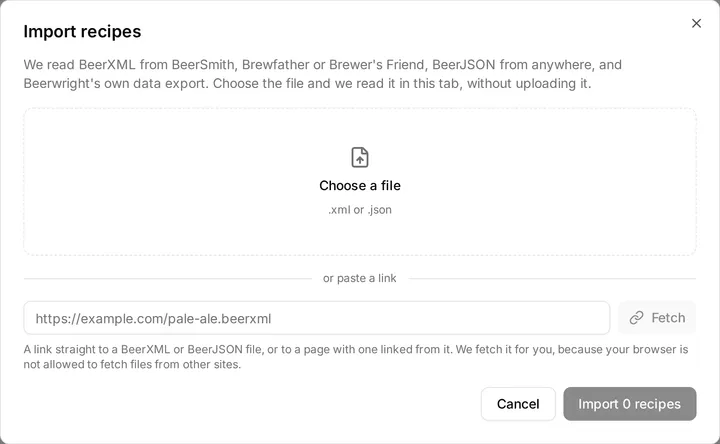
Then Import on the recipes page in Beerwright, choose the file, and read the preview before accepting. The importing page explains the preview and the rule that decides every field: the file supplies every number it stated, and the catalog supplies only what the file could not.
What to expect
Section titled “What to expect”Ingredient names are loose. Brewer’s Friend names ingredients the way its users typed them, which is the way the shop labeled the bag. “2-Row Pale” matches; “Pale malt from the shop by the station” does not. A miss is ordinary: the ingredient is built from the file’s own figures, calculates identically, and is marked as custom in the import notes. If a malt you use often keeps missing, add it as a custom ingredient once and match it by name next time.
Whirlpool and dry hop. A hop stand written as USE=Aroma arrives as
a whirlpool addition with the stated stand time. A dry-hop time of sixty
or less is read as days, over sixty as minutes, which covers both ways
the site’s exports have written it.
Water comes across as a source, not a plan. BeerXML’s water section describes an analysis, and we read it into the recipe’s water panel as the source water, with a second, different analysis read as the sparge water. It carries no salts and no target, because the format has no place for them, so the additions are yours to rebuild in the water panel after import.
Yeast by the pack. A yeast written by weight arrives as sachets of 11.5 g; one written as a small volume arrives as packs. A count is what the yeast panel wants.
The vitals in the file are not used. The preview shows what Brewer’s Friend said beside what we compute, and we keep ours. The two engines model bitterness and color slightly differently, and the FAQ says which models we use.
What does not come across
Section titled “What does not come across”Brewer’s Friend’s brew log, its inventory and its water calculator results stay on the site; a BeerXML recipe has no place for them. Tasting notes, ratings, per-ingredient notes and the file’s style ranges are dropped, and the importing page lists the rest.
Your stock
Section titled “Your stock”Brewer’s Friend can export ingredients as a BeerXML list, and that brings your stock across when the file includes the amounts you have. Choose it with Import on the Inventory page. The inventory page says what comes across and what doesn’t.
Related
Section titled “Related”Something wrong on this page? Tell us.