
Water chemistry
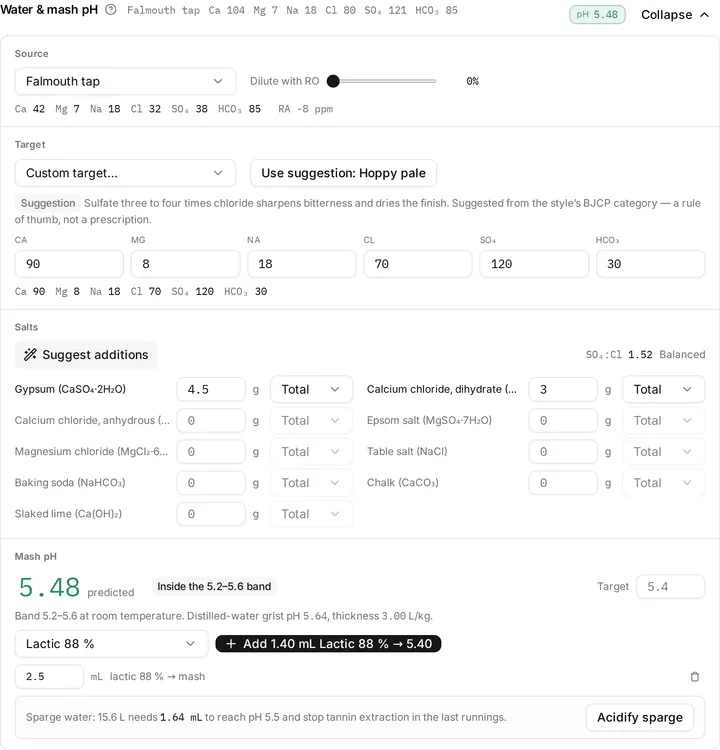
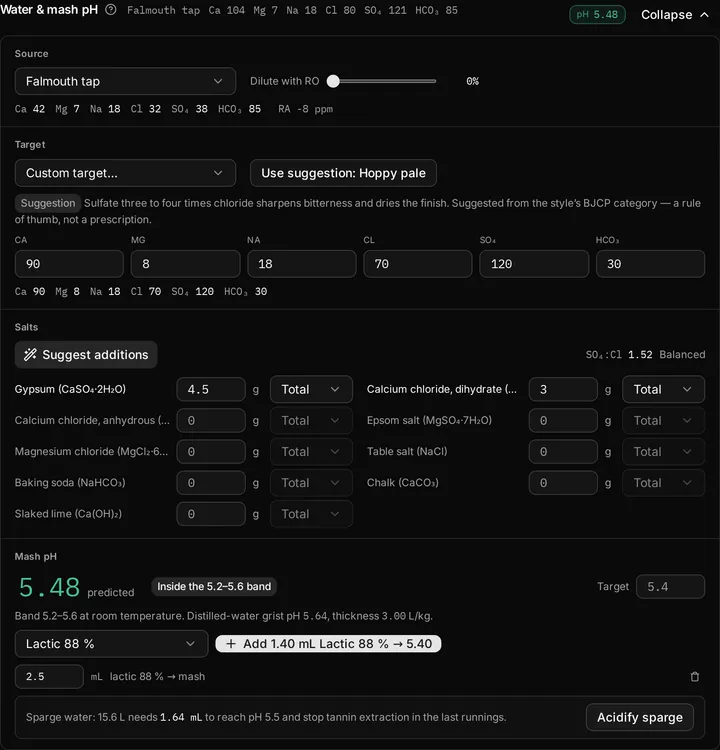
Water is the panel that does the most for you per click, and the one most worth understanding before you trust it. This page walks through it top to bottom.
You will find Water & mash pH near the bottom of the recipe editor. Everything recalculates as you type, salts and pH included.
Starting from nothing
Section titled “Starting from nothing”A new recipe assumes nothing about your supply. Press Set up water and you start from RO, all zeros, so every number you see afterwards came from something you told us.
1. Your water
Section titled “1. Your water”Pick a saved profile, or choose New water profile… to type your own report in. The form takes a name, a measured pH, and alkalinity in whichever convention your report prints. It opens pre-filled with whatever is currently selected, so “mine is like Burton but softer” starts from Burton.
Saving does two things: your report joins your library for every future recipe, and this recipe starts using it.
If a recipe’s water matches nothing in your library — an imported one, usually — you will see its ions inline for editing, marked (not saved), with a Save as profile… button to bring it in.
The built-in profiles
Section titled “The built-in profiles”Seven ship with the app, read-only, so duplicate one to make it yours.
| Ca | Mg | Na | Cl | SO₄ | HCO₃ | RA | |
|---|---|---|---|---|---|---|---|
| RO / distilled | 0 | 0 | 0 | 0 | 0 | 0 | 0 |
| Pilsen | 7 | 2 | 2 | 5 | 5 | 15 | 6 |
| Burton on Trent | 295 | 45 | 55 | 25 | 725 | 300 | 9 |
| Vienna | 200 | 60 | 8 | 12 | 125 | 120 | −80 |
| London | 52 | 32 | 86 | 34 | 32 | 104 | 29 |
| Munich | 76 | 18 | 2 | 2 | 10 | 200 | 99 |
| Dublin | 118 | 4 | 12 | 19 | 54 | 319 | 175 |
These are the historical city analyses every brewing text works from. They are not this morning’s utility report, and for a beer you actually intend to drink, your own report is worth what it costs. Vienna’s negative residual alkalinity is not a typo.
What to fill in
Section titled “What to fill in”The form takes six ions, all in ppm: calcium, magnesium, sodium, chloride, sulfate and bicarbonate.
Calcium, magnesium and alkalinity are required, because your mash pH is made of
them. Sodium, chloride and sulfate you can leave blank, and blank means the
report does not say rather than zero. Those two are different facts, and
Beerwright keeps them apart: a blank ion shows as —, and we will not quote you
a sulfate-to-chloride balance we cannot calculate.
Alkalinity can be entered as bicarbonate, as CaCO₃, or as German carbonate hardness. Tell the form which one your report prints and it converts for you. Getting this wrong is a silent 20 % error in your mash pH, which is why we ask rather than guess.
Residual alkalinity
Section titled “Residual alkalinity”This is the readout worth watching. Your alkalinity resists the mash going acidic; your calcium and magnesium push back the other way. Residual alkalinity is what is left over, and it is the number that actually moves your mash pH. Beerwright uses the Kolbach model, the same one behind most brewing water references.
High residual alkalinity suits dark, acidic grists. Low or negative suits pale ones. That is most of the reason Dublin brews stout and Pilsen does not.
Diluting
Section titled “Diluting”A slider blends your water with RO, up to 90 %. If you dilute, do it here, and everything downstream sees the diluted water.
If your report does not add up
Section titled “If your report does not add up”The positive and negative ions in a real analysis should roughly balance. If yours differ by more than 5 %, we say so while you are still looking at the report, so you can check for a typo or an alkalinity entered in the wrong unit.
If you left ions blank, we say that instead. The gap is expected then, and it is roughly the size of what you did not tell us.
Ward Labs reports
Section titled “Ward Labs reports”The Water tab has an Import Ward Labs button that reads a W-1 PDF and opens a draft profile for you to check. It converts the sulfur figure to sulfate and the alkalinity to bicarbonate, and tells you it did. Review the numbers before you save — it is a draft on purpose.
Any other lab or utility report can be pasted in and read for you. That needs calcium, magnesium and alkalinity; anything else it finds is a bonus, and anything it cannot find is left blank for you to fill.
2. A target to aim at
Section titled “2. A target to aim at”We give you five presets, meant as representative rather than authoritative.
| Ca | Mg | Na | Cl | SO₄ | HCO₃ | SO₄:Cl | |
|---|---|---|---|---|---|---|---|
| Balanced | 75 | 5 | 15 | 60 | 75 | 0 | 1–2 |
| Hoppy pale | 110 | 10 | 12 | 55 | 190 | 0 | 2–4 |
| Malty amber | 90 | 10 | 25 | 110 | 65 | 60 | 0.4–0.8 |
| Dark roasty | 100 | 15 | 35 | 90 | 65 | 160 | 0.5–1 |
| Crisp lager | 45 | 5 | 8 | 45 | 60 | 0 | 1–1.5 |
Give your recipe a style and we will suggest one. Treat it as a rule of thumb rather than a prescription; the panel says as much.
Or just the essentials
Section titled “Or just the essentials”If six numbers is more water chemistry than you want to hold in your head, choose Just the essentials instead of a profile. You set two things: the least calcium the water should carry, and the sulfate-to-chloride balance you are after. The balance is a number, and the familiar words — malty, balanced, hoppy — sit beside it as shortcuts; give the recipe a style and we offer the style’s balance too. Sodium and bicarbonate are left where your water has them, and nothing is said about magnesium at all: most grain bills already supply what the yeast needs.
Suggest additions works the same way from a rule as from a profile. The difference is what it is solving: gypsum and calcium chloride are the two salts that move calcium, sulfate and chloride, so a floor and a balance pin the doses exactly, and the schedule is the smallest one that gets there — one salt when one will do. Salts can only add, so a balance that would take an ion far past the range most brewers stop at is refused rather than weighed out; the panel names the ion and the figure it would have reached, and a lower floor or a gentler balance is the honest way round.
3. Salts
Section titled “3. Salts”Suggest additions works out a schedule for you. It tries combinations of up to three salts, weighs each ion by how much it matters, and rounds doses to 0.1 g, which is what a brewing scale reads. Ask twice and you get the same answer.
The result is staged, not applied. You get a preview with a per-ion target, achieved and difference, plus a badge saying either Every ion in tolerance or Best available fit. Then you press Accept or Dismiss. Accepting is a single step, so one undo puts it back.
The manual salt table below is always there, and is not a fallback.
Each addition can go to the mash, the sparge, or both split by volume.
The salts we know
Section titled “The salts we know”Gypsum, calcium chloride in both its dihydrate and anhydrous forms, Epsom salt, table salt, magnesium chloride, baking soda, chalk and slaked lime.
The two calcium chlorides are listed separately because they differ by about a third in the calcium they carry per gram, and treating them as one thing is among the most common silent errors in brewing water. Check which one is in your cupboard.
Two carry warnings you will not miss. Chalk barely dissolves in a mash tun, so baking soda or slaked lime is a better way to add alkalinity. Slaked lime is potent enough to be worth dosing deliberately. Neither is offered by the suggestion, for those reasons.
Sulfate to chloride
Section titled “Sulfate to chloride”This ratio is the classic flavor balance.
| Ratio | Reads as |
|---|---|
| under 0.5 | Too malty / minerally flat |
| 0.5–1 | Malty |
| 1–2 | Balanced |
| 2–4 | Hoppy / bitter |
| 4 and above | Very hoppy, can turn harsh |
This is a flavor heuristic, not a measurement, and it only means anything when there is enough of both ions to taste. Where there is not, or where your report did not print one of them, we say so instead of naming a band.
Salts can only add ions. If a target overshoots, the only way down is RO water, and we will tell you that rather than pretending otherwise.
4. Mash pH
Section titled “4. Mash pH”Beerwright predicts the pH your mash will land at from your water and your grain bill, and works out what it would take to hit your target.
The prediction uses a charge-balance model: every malt has its own natural pH and its own resistance to being moved, your water pushes in one direction, and any acid you add pushes in the other. Where it all balances is your mash pH. That approach comes from Kai Troester’s work on mash pH, cross-checked against other published models.
The figure is quoted at room temperature, which is where a pH meter is calibrated, rather than at mash temperature. If you measure hot, expect a reading around 0.2 to 0.3 lower.
Where our catalog has a measured pH for a specific malt, we use it. Otherwise malts fall back to sensible figures for their type, and crystal malts are estimated from their color.
If you have not measured your own water’s pH, we assume 7.5. It barely matters: the prediction moves by less than 0.01 across the whole range a tap water plausibly sits in.
One thing worth knowing: alkalinity is measured to a lower pH than a mash actually reaches, so some of it never consumes any acid at all. Beerwright accounts for that, which is why our prediction sits a shade below calculators that do not.
We offer six acids plus acidulated malt: lactic in three strengths, phosphoric in three, citric as the solid, acetic as vinegar, hydrochloric and sulfuric.
How much acid a dose actually delivers depends on the pH you are pulling it to, and Beerwright works that out for each one rather than reading it off a fixed table. It matters more than it sounds: citric acid gives up noticeably less at mash pH than its label chemistry suggests, and calculators that hard-code a figure get it wrong the moment your target moves.
Acidulated malt is grain, not acid. It goes in the grist, and we solve its dose against your actual grain bill, because adding it changes the buffering too. Converting it to “milliliters of lactic” overstates what you need.
The panel offers the one-click version, either Add 2.40 mL Lactic 88 % → 5.40 or Add 150 g acid malt → 5.40. If your target is out of reach, it says so rather than quietly clamping:
Lactic 88 % cannot reach 5.20 at a sane dose.
Related
Section titled “Related”- Mash pH, for the model and its sources.
- Water chemistry, worked, for the salt arithmetic.
- Profiles, for saving a source water and a target.
Something wrong on this page? Tell us.