
Packaging and carbonation
The Packaging panel sits near the bottom of the recipe editor, and on every batch’s page, and answers one question: how do you get the carbonation you want into this beer. Pick a route, and the panel shows the sugar or the regulator setting, and the reasoning under it.
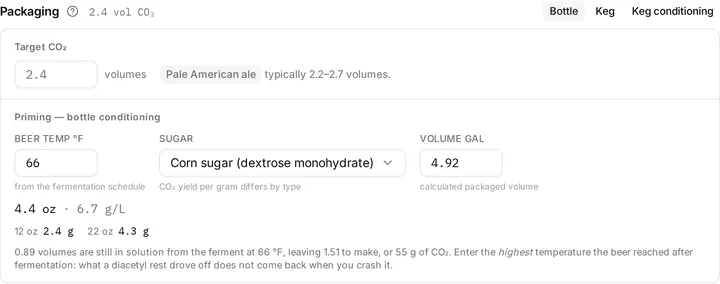
The target
Section titled “The target”Target CO₂ is in volumes, and it is saved with the recipe. A new recipe starts at 2.4, which is the middle of the road for most ales. The allowed range is 0 to 6.
When the recipe has a style, a line under the target names the family and what it typically runs to, and says whether your target is flatter or livelier than that. The bands come from Palmer’s How to Brew and Zainasheff and Palmer’s Brewing Classic Styles, because the BJCP guidelines describe carbonation only in words. The specialty categories have no band, and neither does a provisional style, because inheriting a numbered category’s band by coincidence of its number would be a wrong answer delivered with confidence.
What is already in the beer
Section titled “What is already in the beer”A beer coming out of fermentation is not flat. It holds CO₂ in solution, and how much depends on the warmest it got once fermentation was done. The panel reads that temperature from the fermentation schedule and shows it as Beer temp, with the residual volumes it implies in the note under the dose. Type your own temperature if the schedule is not what happened, and clear the field to go back to the schedule’s figure.
Enter the highest temperature the beer reached after fermentation, not the temperature it is at now. What a diacetyl rest drove off does not come back when you crash it.
If the last step of your fermentation schedule holds a pressure, the panel reads the residual CO₂ off that instead. A spunded beer arrives at packaging already carbonated to some degree, and the dose starts from there. Typing a beer temperature switches you back to the temperature curve. A spunded ferment does not get a discount on the dose. It arrives holding more CO₂, which is a different claim and a measurable one.
Bottle
Section titled “Bottle”Bottle shows the priming sugar as a mass and as grams per liter, then a per-bottle table for the sizes you actually fill: 330, 500 and 750 mL in metric, 12 and 22 oz in US units. Sugar offers corn sugar, table sugar, dry malt extract and honey, and the yield per gram differs by type. Corn sugar is a monohydrate, so it carries water and you need about fifteen percent more of it by mass than table sugar for the same CO₂.
Volume is the packaged volume the calculator predicts. Override it if you know you lost a liter to the trub.
If the residual CO₂ is already above your target, the panel says there is nothing to prime and suggests warming the beer or lowering the target.
Keg conditioning
Section titled “Keg conditioning”Keg conditioning gives the same dose the beer would take in bottles, and then offers the alternative: skip the sugar and spund at the pressure and temperature it names.
That is the full bottle dose, not the reduced one you may have read about. The advice to prime a keg at half to three quarters of the bottle rate is everywhere and sourced nowhere. Even the Brew Your Own column that gives “about 75 percent” says it has never found where the number came from. The arithmetic does not support it either: nineteen liters at 2.4 volumes needs about 89 grams of CO₂ dissolved, and the liter of headspace in a corny keg holds about three and a half grams of it. That is under four percent, and fifty-three bottles’ worth of headspace holds about the same. The real losses come from venting to seat the lid, purging, and poppets that seep, and those depend on your routine. Nobody has measured them, so we do not pretend to.
Seal the keg, leave it somewhere warm for two weeks, then chill it.
Keg is forced carbonation. Set Keg temp to the fridge the keg will sit in, and the panel gives the regulator pressure in your unit with one cross-check unit beside it. Set it and leave it: that pressure at that temperature reaches your target in about two weeks, and it cannot overshoot, because the pressure is the target.
Burst carbonating is faster and at your own risk: 30 psi for a day, then back down. Overshoot and the only fix is time with the gas off. Cold does the work, not pressure.
On packaging day
Section titled “On packaging day”The same calculator is on every batch’s page, so you do not have to go back to the recipe when the bucket is in front of you. It is on the batch’s Packaging card, as Carbonation, under the final gravity and packaged volume it reads. The card opens by itself when the batch reaches Conditioning, and folded it names the route, the target and what you measured, such as Packaging · Keg · 2.4 vol · FG 1.011 · 18.9 L packaged. See the stage cards.
On a batch the panel starts from what you measured rather than what the recipe predicted. Volume is your packaged volume if you have entered it, then your fermenter volume, then the recipe’s packaged volume, and the line under the field says which one it used. The fermenter volume runs a little high, because some beer stays behind with the trub, so enter the packaged volume on the same card once you know it. Beer temp is the warmest fermentation reading you logged, or the schedule’s peak if you logged none.
A route, sugar or target you change on a batch is saved on the batch and never on the recipe, so kegging one batch of a beer you usually bottle does not change the next brew. Beside anything you have changed, the panel shows what the recipe planned, with Use the recipe’s to go back to it. Choose Keg or Keg conditioning and the keg weigh-in card appears under the calculator, even on a batch the recipe planned for bottles.
What is saved and what is not
Section titled “What is saved and what is not”The target, the route and the sugar are saved on the recipe, because a kegger who had to re-pick Keg on every reload told us so, and on a batch when you change them there. Beer temperature, volume and keg temperature are derived each time and are not stored. Storing them would freeze a number that is currently correct by construction.
The brew sheet prints all three routes side by side, with the same vocabulary, so the sheet and the panel never name the same thing differently.
Related
Section titled “Related”- Mash and fermentation, for the pressure field on a fermentation step.
- The brew sheet, where the packaging plan prints.
- FAQ, for where the carbonation figures come from.
Something wrong on this page? Tell us.