
Hops
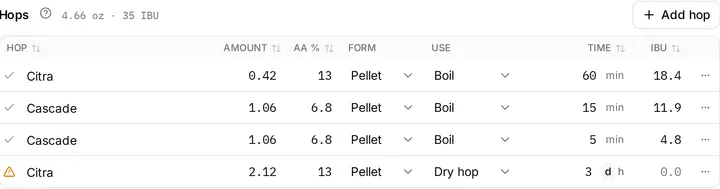
The Hops panel is the schedule. Each row is one addition: a variety, an amount, where it goes and for how long. The IBU column beside each row says what that addition contributes, and the vitals rail adds them up.
Adding a hop
Section titled “Adding a hop”Press Add hop, or A anywhere in the editor, and search. The first addition lands as a 60-minute boil charge; later ones land at 15 minutes, which is where a second addition usually goes and is a shorter walk from there to the whirlpool than from 60.
Alpha acid
Section titled “Alpha acid”AA % comes from the catalog as the middle of the published range, and it is the field you correct from the packet in front of you. It drives the whole IBU number, so it is worth typing. If you add a hop from your inventory, the lot’s own alpha comes with it, because the point of picking a lot is that it is about this bag.
Use and time
Section titled “Use and time”Use decides how the bitterness is calculated.
- First wort goes in before the boil and is counted as a full-length boil addition with a small bonus on top, the ten percent the literature gives it for the gentler isomerisation.
- Boil uses Time as minutes remaining in the boil.
- Whirlpool uses Time as the stand duration, and gains two temperatures of its own under the row. Stand temp is what the kettle read when the hops went in; leave it blank and we assume 80 °C, which is what the gray number in the empty field is telling you. Ends at is what it read when the stand finished, and between them they say how the wort cooled: leave it empty and we use our own cooling curve, type the same temperature you started at for a whirlpool you held there, or type a lower one and we work out how fast it fell. A stand at 80 °C and one at 95 °C give different numbers, and so do a held 75 °C and a kettle that drifted down to it.
- Dry hop contributes no IBU. Time becomes days of contact, or hours if you prefer, and the calendar puts the addition on the day it goes in.
- Keg contributes no IBU either, and it carries no time at all — the beer sits on it until the keg is empty, so the column shows a dash rather than asking you for a number nobody measures.
A steep in two steps
Section titled “A steep in two steps”A steep that sits at 90 °C for fifteen minutes and then at 70 °C for another fifteen is two rows, not one. Make the first a 15-minute whirlpool with both temperatures at 90 °C, and the second a 15-minute whirlpool with both at 70 °C, and put the hops on whichever row you actually added them to, which is usually the first. Each row is then a stand held where you held it, and the bitterness adds up the way the steep did.
One row that goes from 90 °C to 70 °C over thirty minutes is the other way to say it, and it is the right one if you dropped the hops in at the top and let the kettle come down on its own. The two steeps are different beers, and which of them you brewed is yours to say.
Keg hops
Section titled “Keg hops”Hopping in the keg is an ordinary thing to do, so a row can say it. Set the use to Keg and the addition stops bittering, loses its clock, and moves down the page: the calendar puts it on package day, and the brew sheet lists it under Packaging, which is where you are standing when you weigh it out. The Hops panel still shows the row and still counts its weight, because it is still hops. Beer sits on a keg hop, so the volume it soaks up is charged the way a dry hop’s is, after the kettle rather than in it.
Form is whole, plug, pellet or cryo for the cones and powders you buy in a packet, and the utilization follows it. Beyond those, the catalog carries the products that are not cones at all: CO₂ extract, aroma extract and pre-isomerised extract. Add one and it arrives in its own form with its own figures, because adding an extract as a pellet would under-report its bitterness fourfold and nothing on screen would say so. The pre-isomerised extract is the one addition that bitters without a boil.
Terpene products are the exception that is not a hop at all. Bottled hop flavor — Abstrax’s profiles are the ones most homebrewers meet — is dosed in milliliters into finished beer rather than weighed out, so it lives under Misc where a row can say so. Look for it under Hops anyway, because that is where you would look: it turns up in the search marked · goes in Misc, and choosing it adds the misc row and tells you that is what it did.
The record
Section titled “The record”View specs in a row’s ⋯ menu shows the catalog record: acids, oils, the oil breakdown where the grower publishes one, and two rows of chips. Same cultivar lists other origin lots of the same plant. Substitutes lists what the trade reaches for when the variety is out, and in this dialog each one is a button that swaps the row you opened it from.
Hops that have been in the freezer a while
Section titled “Hops that have been in the freezer a while”Alpha acids fade in storage, and a year-old packet does not bitter like the number printed on it. Open the row’s ⋯ menu and pick Adjust for age: tell us how many months, where you kept them and how they were packed, and we work out what is left. We use the Garetz storage model, and where the variety has a published storage figure we use it. Where nobody publishes one we say so and fall back to an average.
If the hop is in your inventory, the dialog opens already filled in. It uses the lot a brew day would actually take this row from — the oldest one that matches, which is the one the deduction empties first — so the months, the place and the packaging are that sack’s rather than a guess. Recording where you keep your hops once, in settings, saves answering it every time.
A lot that also knows its crop year is aged twice over: once for the months between the harvest and the day you bought it, and again for the months you have had it. A hop starts losing alpha when it is picked, not when you pay for it, and the two are often a year apart. For the first stretch we assume a merchant’s cold store, which is our estimate rather than the model’s, and the dialog says so on screen.
Apply writes the new alpha acid onto the row. It is the same field you would type into off the bag, so the IBU moves with it and one undo brings the old number back. We age the alpha only. Aroma fades on its own schedule and we would rather say nothing than guess.
Replacing a variety
Section titled “Replacing a variety”Replace with… in the row’s ⋯ menu swaps the variety without disturbing the schedule. The amount, the use, the timing and the note are yours and they stay. The alpha acid resets to the new variety’s published figure, because the old number was about the old bag and says nothing about the hop that just arrived. The form stays too, unless the new entry is a product that declares its own, a cryo powder or an extract, in which case the row takes it.
Quicker still: open View specs and pick a substitute. Either way it is one change, and one undo puts the old hop back.
Related
Section titled “Related”- Fermentables, Yeast and pitching, Misc.
- The calendar, for where a dry hop lands.
- FAQ, for which bitterness model the app uses and how to change it.
Something wrong on this page? Tell us.