
Mash and fermentation
The mash and the fermentation are two panels, side by side on a wide screen and stacked otherwise.
The mash schedule
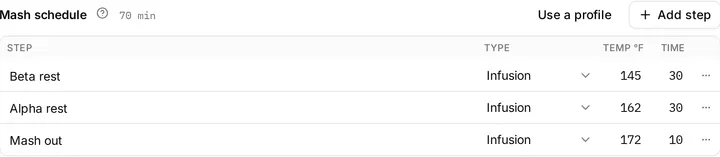
Section titled “The mash schedule”The mash is a list of rests in order, and each has a name, a type, a temperature and a duration.
The type says how the mash reaches that rest:
-
Infusion — water goes in hotter than the target and the mash lands on it.
On any infusion rest after the first you can type the water temperature or the water volume, and we work out the other one and show it grayed out in the box you left empty. Leave both empty and it is boiling water, and the liters of it that rest needs. If the grayed-out figure reads over boiling, the volume you typed is too small to reach that rest: add more, or raise the rest less. If it reads needs hotter water, the temperature you typed is not above the rest it is meant to reach, so no volume of it would get you there. We keep what you typed either way, and the brew sheet says the same thing on the step.
-
Temperature — direct heat, which is what a RIMS, a HERMS or an all-in-one does.
-
Decoction — part of the mash is pulled out, boiled and stirred back in.
-
Sparge — a rinse rather than a rest. It converts nothing and is excluded from the fermentability maths.
What the temperatures do
Section titled “What the temperatures do”Only rests between 55 and 75 °C convert starch, and Beerwright collapses those to a duration-weighted mean to predict fermentability. An acid rest at 40 °C and a mash-out at 78 °C are both excluded rather than averaged in, because neither converts anything.
So a Hochkurz mash of 62 °C for 40 minutes then 72 °C for 20 reads as 65.3 °C — a beer that finishes near the middle — rather than as the 62 °C of its first rest, which would predict something far drier than it ever ferments to.
Cooler favours beta-amylase and maltose, so drier. Warmer favours alpha-amylase and dextrins, so fuller. Profiles ships three single infusions that put numbers on that.
Strike water
Section titled “Strike water”The first rest is the one your strike water has to hit, whatever its type. The brew sheet works out the temperature from your grain temperature, your mash thickness and — if your equipment profile carries one — the thermal mass of a cold tun. That last term is the largest correction on the first brew of the day, and it is why the first mash often undershoots.
Decoctions
Section titled “Decoctions”Set a step’s type to Decoction and the row tells you what to pull:
Pull 6.4 L of mash — 2.6 kg of grain and 2.6 L of liquid
Click that line to open the planner, where you choose how thick each pull is and how long it boils, and can add a conversion rest before the boil.
See Decoctions for what the numbers mean and why they are not the textbook ones.
Using a saved schedule
Section titled “Using a saved schedule”Use a profile lists the schedules that ship and the ones you have saved. Applying one replaces the steps below it, in one undo step. It copies them in, so editing that profile later will not change this recipe.
The same menu has Save this mash as a profile.
The fermentation schedule
Section titled “The fermentation schedule”Stages in order, each with a temperature, a duration in days and a pressure. A stage can ramp instead of holding — set an end temperature and it reads as a ramp.
Two things read this panel:
The predicted beer. Nothing here changes attenuation directly, but the warmest temperature in the schedule sets how much CO₂ is still dissolved in the beer at packaging, which changes how much priming sugar the packaging panel asks for. It is the warmest temperature rather than the last one because what a warm diacetyl rest drives off does not come back when you chill the beer.
Your calendar. Once you brew the recipe, the schedule becomes dates: the batch’s transfer day, dry-hop day and packaging day come from here.
Fermenting under pressure
Section titled “Fermenting under pressure”The pressure column is empty on an ordinary ferment, and empty means open to the air. Fill it in and you are telling us the vessel is sealed with a spunding valve holding it at that pressure. Type it in whichever unit you picked in Settings, psi or bar or kPa, and we will store it and show it back in that unit.
Pressure changes one prediction and nothing else: how much CO₂ is left in the beer. When the last stage of a schedule carries a pressure, the packaging panel starts its priming figure from what that pressure and temperature hold in solution rather than from the schedule’s warmest hour, and it prints a line saying which figure it used. A lager crashed to 2 °C under 10 psi is already at about 2.5 volumes, so the panel will tell you there is nothing to prime.
Two things turn that off. Vent the last stage — clear its pressure — and the peak temperature is back in charge, which is right for a beer that was spunded and then transferred. Or type a beer temperature in the packaging panel, and we take you at your word and read the temperature instead.
Profiles ships a Pressure lager you can apply to see the shape.
What the yeast wants
Section titled “What the yeast wants”If the recipe has a yeast with a published temperature range, the panel shows it. A schedule outside that range is not blocked — kveik is pitched hot on purpose, and a lager brewer knows what they are doing — but it is worth a second look if you did not mean it.
Related
Section titled “Related”- Decoctions, for the mash step this page only names.
- Water chemistry, which reads the mash schedule to work out pH.
- Yeast and pitching, for what the fermentation schedule is for.
Something wrong on this page? Tell us.